Application
XGrid L2 Pro is a flagship handheld 3D laser scanner that represents a significant technological breakthrough. By deeply integrating LiDAR, visual, and IMU sensors, and combining them with AI intelligent algorithms, it achieves a "zero post-processing" real-time scanning and modeling capability. It employs a self-developed Multi-SLAM fusion algorithm, which greatly enhances adaptability and reliability across various scenarios. Even in challenging environments with weak features and repetitive structures, such as underground utility tunnels and subway tunnels, it maintains stable mapping performance, effectively avoiding issues like trajectory drift and point cloud layering.
In terms of precision, the scanner boasts an impressive absolute accuracy of up to 3 cm and a maximum scanning rate of 640,000 points per second. Its proprietary point cloud enhancement algorithm generates dense point clouds with a point spacing as low as 1 mm and a point cloud thickness of merely 5 mm. Coupled with exceptional color accuracy, it delivers a photorealistic colored point cloud effect, precisely replicating every detail of the real-world scene.
Furthermore, its integrated wireless design significantly improves operational convenience. The device weighs approximately 1.7 kg, and its built-in battery supports about 1.5 hours of continuous scanning. Users can view colored point cloud data in real-time via a mobile app without needing a computer connection, allowing for immediate quality checks on-site and greatly enhancing field work efficiency

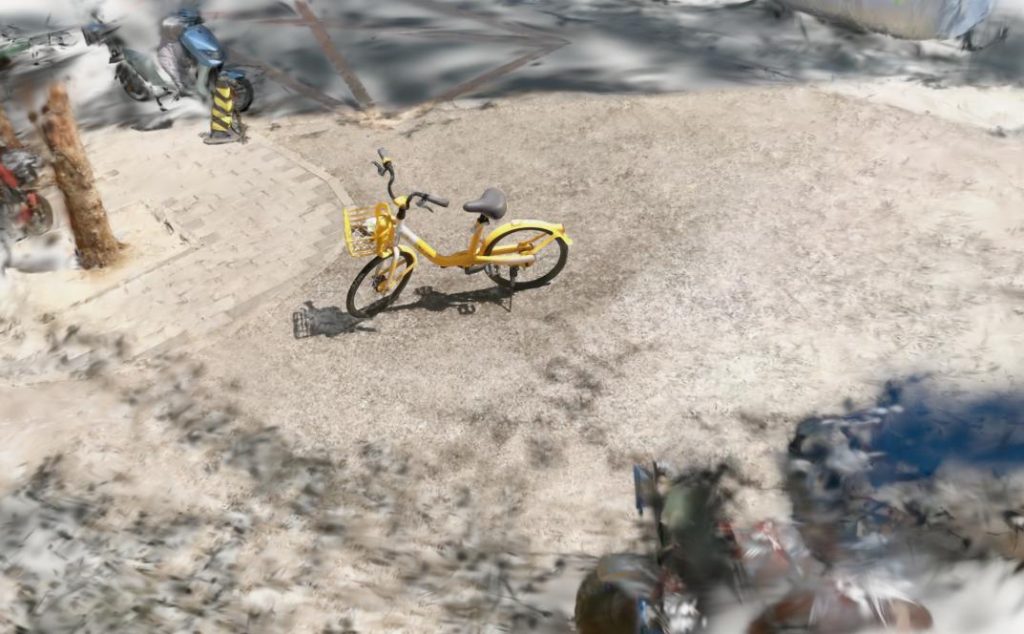
The Gaussian Splatting technology integrated into the Lingguang L2 Pro brings a revolutionary improvement to the realism of scene reconstruction. Unlike traditional triangle-mesh-based modeling methods, this technique utilizes millions of Gaussian spheres rich with spatial attributes (such as position, color, transparency) to construct scene models.
This approach is particularly adept at handling complex lighting, shadows, and translucent materials—such as light filtering through leaves, refractive ripples on water surfaces, or morning mist in forests. Its rendering error can be reduced by over 90% compared to traditional methods, endowing digital scenes with unprecedented vibrancy and realism. In small-scene modeling demanding extreme precision, such as fine cracks on cultural relic surfaces or logos on industrial equipment, details can be clearly reproduced down to the centimeter level.